Monday, 21 May 2012

Trip to the Aquarium


went home to London this week to see the family, and of course to take a trip to the Aquarium and London Zoo. In all honestly I didn’t have a strict plan of what I wanted to achieve by visiting these organizations. I figured inspiration would suddenly hit me whilst walking around the enclosures…

And luckily it did! The intense colours and patterns of the various fish captivated me. There was so much going on that my eyes didn't know where to focus. I photographed and videoed the various movements, patterns and textures of the tropical fish. Here are a few examples… 


Friday, 18 May 2012

The World in our Hands


The Natural History Museum Wildlife Photographer of the Year exhibition.

Every year I go to the Wildlife Photographer of the Year exhibition and every year I’m blown away by the beauty, quality and originality of the photographs submitted. For me the annual exhibition never gets old. There are a variety of categories from animal portrait to underwater worlds. But it’s thecategory that shocks me and stays in my mind the longest. The photographs are extremely powerful and thought-provoking. They draw attention to the cruel state of the world and how man has monopolized the planet, destroying everything that gets in his way The images are almost always pessimistic, aimed to create awareness, which will hopefully inspire people to change the way they live and protect what we have.

But I wonder if I – and other people – have become immune to images like this? Have I seen so many disturbing photographs that I’ve become desensitized? Will I really remember these images after I’ve left the exhibition? I do want things to change, but do I really want to change the way I live? I suppose I question what I or anyone else can really do. Is buying free-range eggs or haddock instead of cod or animal friendly skin care really enough anymore? And why do I do that anyway? Is it just to make me feel good about myself, to think I’m changing the planet, slowly but surely? I guess what I’m saying is – I think these photographers are really good at getting people to think, but will it actually make a difference? Anyway, that’s a completely different topic, and I don’t have any answers, just conflicting views that go round in circles.


The photographers use a number of techniques to create awareness and sympathy for the endangered animals and wildlife. Some show humans very obvious mark on the planet, for example the lone tree surrounded by tier tracks. The image is cut in half showing the before and after state of the forest. The reflection of the tree in the muddy puddle is a window into the future, showing us the forest’s fate, soon all that’ll be left of this beautiful woodland is churned waterlogged earth.


Frederic Larrey’s photograph of the fisherman and the reflected fish is beautifully shot, taken from and unusual and intriguing angle. The reflection distorts the fish, blending them into the water.  Like the previous image, the composition is split in two, with nature on one side and man on the other. The net looks like patterned cloth blowing in the wind, and at first glance I focus on the textures and colours of the fish. However, the darkness at the top of the net spreads over them, bringing an ominous feel to the piece. The shadows of the net are encaging the fish, taking them away from the calm water and into the waiting fisherman’s arms.


Wednesday, 16 May 2012

Kai Fagerström - Photographer

The House in the Woods


I've looked at animals being photographed in the wild by Nick Brandt and Steve Bloom, and in captivity by Britta Jaschinski. Now I want to compare my findings to wild animals in an urban landscape, opposed to the beautiful settings of Africa and gloomy corners of the zoo.


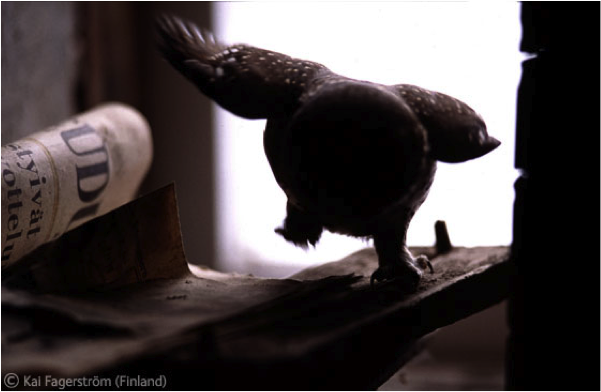
Kai Fagerström is a Finnish documentary photographer. His photographic series, “The House in the Woods”, documents the inhibitants of an old, crumbling and deserted house in the woods, near Salo, Finland. The isolated house is probably at least 200 years old, with its last dwellers moving out more than 30 years ago. Who were the last inhabitants and where are they now? “It's as though time stood still.” They left behind many of their previous belongings, old-fashioned lampshades, tables and chairs, lying dust covered on the floorboards. The house has weathered over time, taken over by the wood, the wind freely blowing its leaves around the kitchen and the rain never fails to drip through the holes in the roof. The cracked peeling walls, creaking floorboards, and dirty smashed windows seem to have their own life, turning the house into a reflection of the wild woods outside.


However the house is not as concealed as you may think, for when dusk falls on the gloomy stone walls, life suddenly takes over. The various creatures in the woods make their way back home. The raccoon family has their own private entrance to the house, the fireplace. Red squirrels busy themselves in their nests in the kitchen and badgers shuffle around under the floorboards. The house offers them shelter from the harsh winter winds, a safe place from the watchful eyes of the ever-hungry birds of prey. This house is their home.


Fagerström spent a lot of time at the house, once daylight has slipped away. He patiently waited for the animals to appear, wanting to photograph their goings-on and everyday activities. He says that at night, “the light can be beautiful.” The creatures that inhabit the house stop by the same time every evening, though some are more photo-shy than others. The owl seemed to know his way round the house, as if he'd lived there previously, now become more of a passing visitor; “It wasn't too shy, so photographing it was quite easy." He lured the animals into particular positions, tempting them with nuts and food, so he can get his ideal compositions.


I love the atmosphere of Fagerström’s photographs. The house seems beautifully quiet and peaceful, with the yellow light bouncing off the walls, giving a sense of safety and security. Like the other photographers, Fagerström humanises the animals, however in a completely different way. Rather than trying to show their expressions of pains, sorrows or empowerment, through portrait-like photography, Fagerström focuses on the documentary side, looking at their home life and behaviour.  The animals look content in this man-made environment, as though it is of their own making. This makes me relate to my every day routines at home; the image of the red squirrel peering out of the window looks as though he's waiting for a friend to arrive for lunch. 


The dark lighting in the images is perfect, it doesn't expose or illuminate the animals too much, creating a sense of mystery and anticipation. Fagerström respects their space and is very much an onlooker on the scene, rather than an intruder. The creatures seem very content with their secret hideaway. Although they are living in the ruins of an old human dwelling, let's just hope that Fagerström is the only person to discover their hidden home.


Monday, 14 May 2012

Wildlife Photographer - Britta Jaschinski


I first saw Britta Jaschinski's work at the Wildlife photography of the year exhibition at the Natural History museum last year. To me, her black and white Lion portrait holds so many emotions, whilst demonstrating her eye for beauty and skills as a photographer. The image is out of focus, grainy and very high contrast, which is how I was taught not to take a photograph in my A-level photography class! However I believe all this adds to the emotional impact of the image. She has captured a fleeting moment of the lion, showing how rare it is to see such a beautiful creature from such a close proximity. The off focus and high contrast of the image emphasizes the elegance and texture of the lion's mane. Most of the lion's body is engulfed in blackness, which to me provokes an eerie feeling about how African animals are starting to slip away, leaving behind just brief glimpses and fading memories from old photographs.


Her Zoo Project - 


Like me, Britta Jaschinski's photographic projects, to explore animals in captivity, were developed at London Zoo. She photographed animals in zoos, focusing more on their portraits and personalities than documentation. In an interview Britta says "the more photos depicting the truth about captive animal, the better". She feels very strongly that zoos are wrong which was reflected in her work; "the subject matter of zoo is a very depressing one for me. Much pain swept through my lens and a lot of that agony created those images. I framed boredom, frustration and insane animals and I wouldn't ever know how to produce a bright image on that."


Jaschinski felt "naturally drawn towards animals" and started off by documenting the treatment of them in farms, slaughterhouses and animal testing laboratories. On her first trip London Zoo she says she, "spent hours taking photos and when I processed the film I was shocked about my discovery"..."And here it was, right front me - my own photos explain to me why I felt depressed about the fate of these sentiment beings who had been incarcerated in the name of education in conversation. Each of the species is locked into a version of hell, purely for entertainment. From then on I felt it was my duty to visit more and more zoos to investigate whether the are actually zoos that play an active role in the education and conserving."


Jaschinski's use of black-and-white engulfs the animals, creating a dark pessimistic atmosphere; her photographs show a bleak and melancholy look on animals in captivity. They hold a sense of unease, making the viewer feel slightly uncomfortable. You are more able to sympathise with the animals, because the style of the photographs are more like portraits, than documentary. This humanizes the animals, showing them in states, such as isolation and frustration, to which we can relate... They look as though they’ve given up on the world, and all that is left is a meaningless existence, for the satisfaction of people’s need for entertainment. They seem like empty shells with no life left in them, just staring helplessly into space; even the structure of the composition locks the animals in a rectangular cage. 


The unnatural urban environment stands out as an oddity, as we’re used to seeing photographs of animals in their natural environment. But who knows, maybe in the future this is the only way animals will be perceived, in an urban landscape surrounded by metal bars or thick scratched, scarred glass. 

Friday, 11 May 2012

New Project Brief


Now that Bristol Zoo has rejected my volunteering application I have to find another activity to take up my time during these next few weeks. After much consideration I decided to stay on the animals in captivity though process and take trips to Bristol and London Zoo where i can photograph and sketch animal activities.

Since looking at the work of wildlife photographer; and understanding the increasing risk of extinction, I’ve become more and more interested in the comparison between animals in captivity and animals in the wild. I put some of my thoughts to paper with a spider diagram...


Wednesday, 9 May 2012

Final Correspondence with Bristol Zoo

I waited another week for the Zoo to get back to me and still no reply. This led to another awkward phone call, turns out they have received my application, but not had time to consider it. I somewhat desperately I explained time was an issue and I really needed to get my project sorted. The women assured me they would reply within the week, though most likely she was trying to stop me monopolising her phone line.

However another week has come and gone and, surprise surprise, still no word! So feeling like a complete nag I e-mailed the zoo one last time, stating that I really need to know before next Monday or will have to with draw my application.

The next day I finally received an answer! Unfortunately, though not too surprisingly, it was a no. Very disappointing! At least this painful drawn out correspondence has finally come to an end! Now on to plan B, or is it C, anyway once I've figured out the plan I'll let you know...


Tuesday, 8 May 2012

Wildlife Photographer - Steve Bloom

Steve Bloom is another of my favourite wildlife photographers. He works both in black and white and colour, which create entirely different effects. Like Nick, Brandt his images are incredibly striking, showing animals at their most powerful and beautiful states. 


The images are very dramatic and atmospheric, with landscape playing a key role in the composition. Bloom often depicts the animals in ominous weathers, being engulfed with swiping mist, or heavy rain storms pounding upon them. This creates a strong sense of power and resilience from the animals, exaggerating the trials of their everyday lives. All the while capturing their beauty, which is enhanced through the use of black and white photography, emphasising the contrast of tones and textures without being distracted by colour.
Many of his photographs are very artistic, taken from unusual angles and close ups. In his photo of the elephant emerging from water, (below), it hard to see where the elephant's trunk ends and the water begins. The texture of the elephant's trunk looks that of a tree trunk, with the water as long roots being ripped from the earth. 

Bloom's photography that play with exposure times are the most stunning. The movement and urgency are burned so deeply into the photographs that I can almost hear hooves on the grassy terrain. The galloping horses image below has strong drawing qualities, the out of focus horses look like the shadow of a ghosts or spirit. Or a forgotten memory or dream, trying to remerge in your mind, then slipping away in the blink of an eye. To me the image not only shows the pureness and strength of the horses but holds such emotion that the horses become a metaphor for some greater unknown power in the world. 


Bloom's colour photographs, again like Nick Brandt, can't help but display the personalities of the animals. By humanising the creatures it makes us able to sympathies and connect with them, allowing us to share their simple pleasures or feel their heart break and despair. Hopefully this with speak out to the human race bringing change to the ever increasing extinction of endangered species, showing that they are closer to us than we once thought.
This short clip shows Steve Bloom's thought on the importance of wildlife and his process as a photographer trying to make in impact on people.


Monday, 7 May 2012

Wildlife photographer - Nick Brandt

Nick Brandt is one of my favourite photographers. I only discovered him very recently, when I saw his book "A Shadow Falls" at the Natural History Museum. His photographs are truly breath taking. The images are so intense I feel as though I'm looking through a window into a new world, which I could easily pass through. He is able to capture such human emotion through the animals, giving them personalities and feelings with which you can really connect. 


The black and white brings such beauty, elegance and emotion to the photographs, making the viewer focus on the elaborate details, from the creases on a elephant's trunk to the thin hairs on a lion's maine.       

The compositions are very dramatic and empowering, showing off the magnitude and strength of these african animals. The images look more like illustrations of what theses animals should look like, rather than documentary photography; the compositions are just so perfect they seem unreal.

What I find most inspiring about Brandt's work is his focus on the extinction of these beautiful animals and make us see how much we overlook them. The image of the elephant above is entitled, "Elephant Drinking, Amboseli, 2007. Killed by Poachers, 2009." 
Brandt set up the Big Life Foundation is 2010 to increase the protection of these soon to be extinct animals. This foundation has already reduced the amount of poaching in various areas around Africa and has lead to some significant arrests of some of the worst poachers in the regions. 


I think that Brandt really connects to his subject matter and expresses his love for the animals through these affectionate images. I really admire the way in which he's trying to put a stop to poaching and opening people's eyes to the reality and wonder of these extraordinary animals.


Friday, 4 May 2012

Volunteering at Bristol Zoo Updates

So now its been over a month since I sent off my application form to Bristol Zoo and still no word! I'm starting to get a little concerned so resulted to my least favourite task of calling the volunteer department to see if they have received my application. And, of course, as luck is forever against my favour, they have not. It's gotten lost in the post so now my genius early bird idea is not so genius!

But the lady on the phone said I can e-mail my application to her. This will hopefully take less time to receive an answer, than via post, and as my project has now officially started, time is growing thin...

P.s turns out Lorikeets are like parrots!

Thursday, 3 May 2012

Animals Inside Out

Natural History Exhibition - Animals Inside Out 
6th April – 16th September

Over Easter while is was in London I went to see the Animals inside out exhibition at the National History Museum. The exhibition exposes the detailed muscle structure and entwining veins under animals’ skins, from a tiny frog to a humongous elephant. It was really interesting, allowing you to discover the ins and outs of 

Each animal’s anatomy, from the nerves to the muscles and how each species varies from another.

To preserve the intricate blood systems within the animals, coloured liquid resin is injected in the main arterial network. When the surrounding tissue is removed from the animal a perfect structure of vessels is revealed. This insight into the animals blood system is truly breath taking. It looks so unreal; you have to keep reminding yourself this is really what is under animal’s skin.


Until this exhibition I had never heard of Plastination. This is a fairly new method, (1977), of preservation created by Dr Gunther von Hagens. Plastination is the extraction of all water and fatty tissues from the specimen and replacing them with polymers in a vacuum. This stops the natural decay of body parts and allows scientists to study the subjects for long periods of time; it is also odourless which makes the process a lot pleasanter.


What I found most interesting were the animals that were sliced into very thin layers. In particular the giant giraffe, in the middle of one of the main rooms, was cut into about 50 pieces. You were able to get very close and examine the transparent pieces; looking at them individually, or from below so you can see all the layers together.

The thin layers of blood and muscles formed intricate patterns, which were very beautiful and to me looked more like a piece of artwork than a body part.


Dotted around the walls in the exhibition were microscopic photographs of animals sliced in half. Theses photographs are incredible and look just like drawings. The detail is truly amazing and it does look like a wafer thin slice taken from inside the animal.


Tuesday, 1 May 2012

E-mail to Bristol Zoo

So on the 15th of march, (being the early bird and all), I sent Bristol Zoo a very long and detailed e-mail, asking for a work experience placement, and not too surprisingly they e-mailed back the next day with a very short reply...


On to plan B! I may not be able to do work experience but I can still volunteer! Looking on the website I found a few volunteer roles which sound pretty interesting, Children's craft volunteer role, Ranger volunteer and if worst comes to worst gardens volunteer.

I really like the sound of children's craft; "Spend your day being creative in our Activity Centre. It’s run by volunteers and attracts lots of young visitors, so you can get involved in face painting, badge making, brass rubbing, necklace making and other activities."- So basically being creative, friendly and enthusiastic, which I have pretty good practice at, having a younger brother.

But what sounds really good is the Rangers role, "We’re looking for confident people who enjoy talking to the public and are willing to learn lots about lemurs*, butterflies and lorikeets. You’ll be based in the Lemur Walkthrough*, Butterfly Forest or Feed the Lorikeets sections of our new Explorers’ Creek, where you’ll answer questions and make sure both visitors and animals are behaving themselves!" - Sounds good right! I'd love to talk to people about lemurs, though knowing my luck I'll probably be stuck in the Butterfly Forest, and lets be honest, who wants to go there! But I guess it would be better than the Lorikeets as I have no idea if they're even a mammal or reptile, so may be potentially problematic having to answer questions about a, for all I know, fictional animal! (Note self - research needed!)So before Easter I sent off my application form so hopefully should hear back relatively soon, fingers crossed! 

Monday, 30 April 2012

Project brief

So now that I've handed in all my practical work, research and numerous journal scribblings, I find myself at the beginning of a long six week project, with no idea where to start.

Desperately searching for inspiration I look back on my last, and unfinished, project based on photographs taken at Bristol Zoo. It was the first time I'd visited this particular Zoo; and yes, I must confess, I was very sceptical upon arrival, never imagining it would live up to the famous, and somewhat pretentious, London Zoo, or should I say, the Zoological Society of London. The latter is where I spent my childhood, dragging my mother and father around the enclosures, after endlessly begging to my mother to take me there on a sunny bank holiday. However to my surprise I found myself captivated by this smaller and more personal organisation. The main attractions, lions, gorillas and so on were incredibly well laid out, allowing the excitable viewers to get dangerously close to the action. There were also some good interactive zones, where one is allowed to freely walk around the lima or butterfly enclosures. Though I must confess I was a little disappointed when a lima didn't sudden have an urge to climb upon my shoulder and allow me to stroke its back, but there is alway next time.

So I thought, why not apply for work experience at Bristol Zoo? They must need young, enthusiastic students, with absolutely no experience, and studying a degree completely unrelated, right? So this will be my project, following zoo keepers, taking photographs and studying animal activity, what could go wrong!
I shall be documenting my journey throughout, via this blog, though this is just my brief so goodness knows what it will turn out like - here goes!